Captive-bred California condors lack role models to show them how to survive in the wild. But wildlife biologists helping them navigate the modern world. By Susanne Bard
Many animals, from whales to chimpanzees, pass on survival skills through the generations. When California condors went extinct in the wild more than 30 years ago, their cultural traditions were erased, leaving young captive-bred birds vulnerable when they were released into their natural habitat again. For example, baby condors need calcium. Wild condors used to supply it by bringing calcium-rich bones into the nest. But without role models to show them what bones look like, young birds rely on instinct, often bringing back trash resembling bone instead. Condor chicks can die if they ingest the bottle caps and glass that their parents mistake for the real thing.
“They go after anything that is small, hard, catches their eye, and the chicks don’t know anything different,” explains San Diego Zoo Institute for Conservation Research wildlife biologist Mike Wallace. The trick is to teach the condors to distinguish between bone and trash before they start nesting. “Young birds that don’t have any cultural transmission from their true parents in the wild, they’re learning as they go and so they’re picking up bad habits and we’re trying to break those habits, says Wallace. After the released birds start nesting, the researchers test the birds’ knowledge by placing manmade objects outside their nests, alongside bone. “It seems to be changing in the culture of the condors over time,” says Wallace.
Many other hazards await the condors when they’re released back into the wild, such as lead shot and wind turbines. Ingesting lead can cause death by poisoning. Wind power, while offering a green alternative to fossil fuels, has different perils. Collisions with turbines can kill. To address the problem, the condor biologists have teamed up with energy companies to minimize the risk. Wallace says one solution involves attaching GPS transmitters to condors. “We’re designing a transmitter that will go on the wing of the bird and it’s going to alert the office as to the position of the bird in relation to the wind turbine,” he says. “So as the bird comes towards the turbines, if it’s 15 miles out, we’ll get a weak alert letting us know there’s a bird coming. As it gets to 10 miles and 5 miles the alerts will become more critical, and even to the point of shutting down turbines if the bird is heading right in that direction. So in this case the transmitter will be working as an early alert system for the birds getting into danger and then we can change our behavior.” Wallace explains that warning lights and sounds could also be deployed to encourage the bird to fly in another direction. He and his team are planning to test the system in Baja, California in the near future.
Another intervention, which may seem far-fetched at first glance, is to use drone aircraft to help teach young condors where to find food. There’s an old cartoon trope that when you see vultures flying overhead, it must mean there’s something dead or dying on the ground. “That proverbial image of a cowboy crawling through the desert with vultures circling overhead, it’s very very true,” says Wallace. Condors are a type of vulture, but young captive-bred birds have never actually witnessed older condors doing this, and they often rely on researchers to provide food for them. To encourage food independence, Wallace’s team places animal carcasses in Baja, California, where the condors went extinct back in the 1930s. Then they fire up some drones. “You can program a fixed-wing drone to fly out to a specific GPS point and circle at an altitude that you prescribe,” he says. The condors aren’t too picky about their role models. A circling drone is good enough to fool a naïve young bird. Once they’re trained to expect food below the aircraft, Wallace thinks the birds could be lured out to the coast with drones, where they’ll find plenty of dead marine mammals to sustain themselves.
More than 450 California condors are alive today. Their future survival depends on the efforts of dedicated conservationists to teach them how to be wild birds again

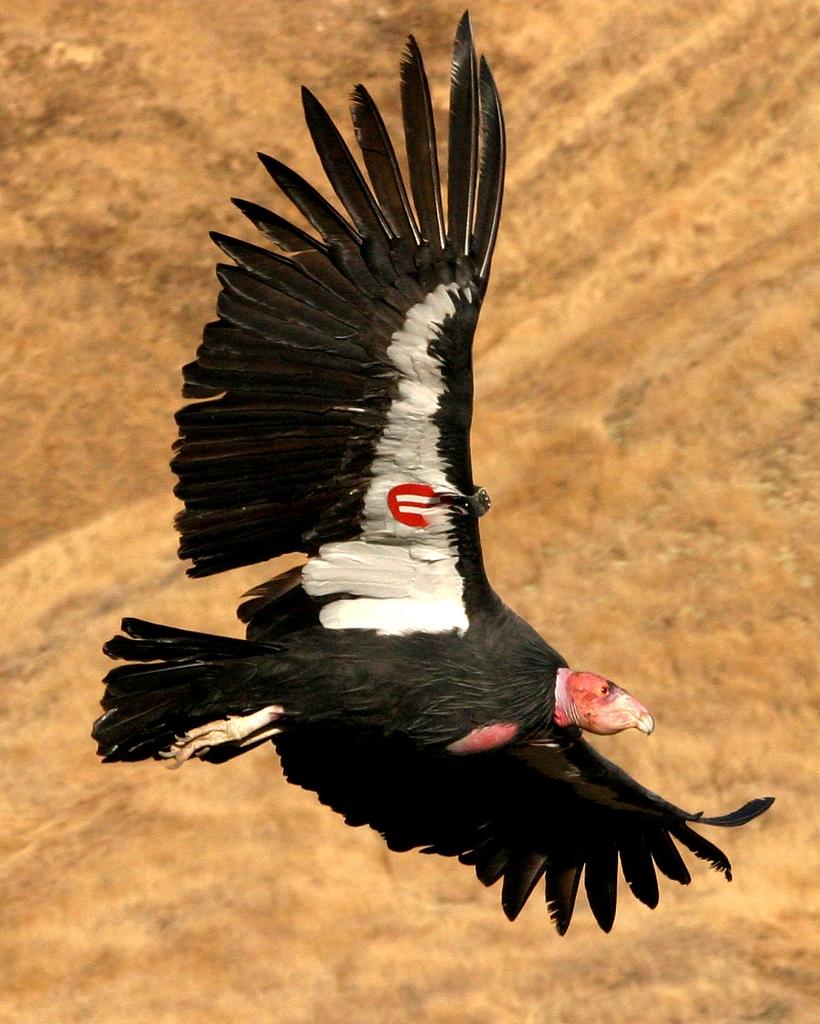
A California condor in flight. (Phil Armitage/Wikipedia/
/Public Domain)
Listen to theAAAS Science Update podcast version of this story, written and co-hosted by Susanne Bard.
 Susanne Clara Bard